
AC Panel Velcro Melting: Causes, Prevention & What to Do
While adhesive failure on AC panels is relatively uncommon, it can happen when excessive heat builds up around the window or panel.
If you’ve noticed your panel shifting or the Velcro coming loose from the window frame, heat exposure is the most likely cause.
At Aircon Rescue, we’ve seen this occur in specific situations where airflow is restricted, window temperatures become excessive, or the adhesive has been exposed to prolonged environmental conditions. This guide explains the most common causes, how to prevent them, and what to expect if repairs are required.
Important: Understanding Velcro Adhesive
The commercial-grade Velcro adhesive used on our AC Panels is designed to provide a secure attachment under normal operating conditions.
However, like all pressure-sensitive adhesives, it can soften or release when exposed to excessive heat or prolonged environmental exposure.
Because every installation is different—including window orientation, frame material, sunlight exposure, portable AC performance, how the unit is operated, and environmental conditions—Aircon Rescue Inc. does not provide a warranty or guarantee against adhesive failure caused by:
- Excessive heat
- Direct sunlight
- Restricted airflow
- Windows not opened sufficiently
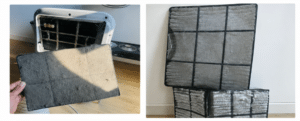
- Dirty or clogged filters
- Air conditioner malfunction
- Hot metal window frames
- Operation in Dehumidify (Dry) Mode
- Improper seasonal storage
- Other environmental conditions beyond our control
Adhesive failure resulting from these conditions is considered normal environmental exposure rather than a product defect.
If repairs are required, they are treated as a standard billable service call.
Why Velcro Adhesive Can Fail
1. Restricted Airflow from the AC Unit
Portable air conditioners rely on unrestricted airflow to exhaust hot air outdoors.
When airflow is restricted:
- Hot air remains around the panel.
- Heat reflects back toward the window.
- Surface temperatures rise rapidly.
Common causes include:
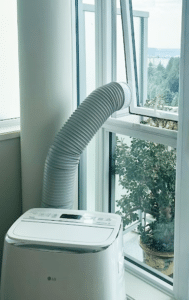
- Kinked or compressed exhaust hoses
- Dirty air filters
- Dual-hose units forced into tight bends
- Portable AC units working harder than normal
Over time, this concentrated heat can soften the adhesive.
How to Prevent It
- Keep the exhaust hose as short and straight as possible.
- Avoid kinks or sharp bends.
- Clean your AC filters regularly.
- Ensure unrestricted airflow around the portable AC.
2. Window Opening Too Small
Portable air conditioners require sufficient window opening to allow hot exhaust air to escape efficiently.
Some casement and awning windows simply cannot open very far. When the opening is less than approximately 6 inches, hot exhaust air can become trapped between the acrylic panel and the glass, causing temperatures to rise significantly.
Windows that open less than 6 inches have a substantially higher risk of Velcro adhesive softening or releasing because the heat has less space to dissipate.
This is one of the most common causes of adhesive failure.
How to Reduce the Risk
- Open the window as far as it will safely open whenever the portable AC is operating.
- Keep the exhaust hose as short and straight as possible.
- Clean the AC filters regularly to maximize airflow.
- If your window opens less than 6 inches, periodically inspect the Velcro during periods of hot weather, as these installations are naturally more susceptible to heat buildup.
3. Dirty or Clogged Air Filters
A dirty air filter is one of the most common and most overlooked causes of excessive heat buildup in portable air conditioners.
Most portable AC units have a removable filter near the top or rear of the unit that filters the room air before it passes over the evaporator coil. This filter is easy to access and should be cleaned regularly.
Many higher-quality portable air conditioners also provide access to a second filter or intake near the lower portion of the unit. This lower intake supplies cooling air to the condenser section of the air conditioner.
However, some lower-cost portable AC models do not provide access to this lower intake or condenser coil. Over time, dust, lint, pet hair, and debris accumulate inside the unit, restricting airflow through the condenser.
When condenser airflow becomes restricted:
- The condenser cannot reject heat efficiently.
- Internal temperatures increase significantly.
- The compressor works harder and runs for longer periods.
- Exhaust air becomes much hotter than normal.
- More heat builds up around the AC panel and Velcro.
- Cooling performance gradually decreases.
In severe cases, restricted condenser airflow can cause exhaust temperatures to exceed 140°F (60°C) well beyond the temperature range that pressure-sensitive Velcro adhesives are designed to withstand. At these temperatures, the adhesive can soften, lose strength, and eventually release from the window frame.
If left unaddressed, a clogged condenser can also lead to poor cooling performance, increased energy consumption, premature compressor wear, and ultimately failure of the portable air conditioner.
This is one of the most common maintenance issues we encounter with portable air conditioners.
How to Reduce the Risk
- Clean the removable air filters every 2–4 weeks during the cooling season, or more frequently if you have pets.
- If your portable AC provides access to the lower condenser filter or intake, clean it regularly according to the manufacturer’s recommendations.
- Some portable air conditioners do not provide access to the lower condenser coil or intake. Over time, dust and debris can accumulate inside the unit with no practical way to clean it without completely disassembling the air conditioner. This is a design limitation found on some models and can eventually lead to excessively hot exhaust air, reduced cooling performance, premature failure of the unit, and melting of the velcro adhesive.
4. Extended Exhaust Hoses
Portable air conditioners are designed to operate using the exhaust hose supplied by the manufacturer.
Using an extension hose or increasing the hose length beyond the manufacturer’s recommendation can reduce airflow through the exhaust system.
This may result in:
- Reduced exhaust airflow
- Increased internal temperatures
- Hotter exhaust air
- Additional strain on the portable AC
The hotter exhaust air can increase temperatures around the AC panel and contribute to adhesive softening, particularly when combined with small window openings or restricted airflow.
How to Prevent It
- Use only the exhaust hose supplied or recommended by the manufacturer when ever possible.
- Avoid adding extension hoses unless specifically approved for your AC model.
- Keep the hose as short and straight as possible.
5. Low Refrigerant or Air Conditioner Malfunction
Portable air conditioners that are malfunctioning or low on refrigerant often run hotter than normal.
Poor cooling performance usually means the unit is working harder, producing hotter exhaust air that can contribute to adhesive failure.
How to Prevent It
If your portable AC is no longer cooling effectively, have it inspected before continuing to use it.
6. Hot Metal Window Frames
Metal and aluminum window frames exposed to direct sunlight can become extremely hot during the summer.
The Velcro adhesive is applied directly to the window frame, so prolonged exposure to these elevated surface temperatures can soften the adhesive—even if the air conditioner is operating correctly.
This is more common on:
- South-facing windows
- West-facing windows
- Dark-colored aluminum frames
- Windows receiving prolonged afternoon sun
7. Improper Storage of the AC Panel
After the cooling season, AC panels should be stored indoors in a cool, dry location.
Leaving panels outside, in sheds, greenhouses, hot garages, damp basements, or other high-temperature or high-humidity environments can gradually weaken the adhesive before the next season.
Extended exposure to:
- High humidity
- Extreme summer heat
- Direct sunlight
- Freeze-thaw cycles
can shorten the life of the adhesive.
How to Prevent It
Store your AC panel flat in a clean, dry indoor location away from excessive heat, moisture, and direct sunlight.
8. Using Dehumidify (Dry) Mode
Many portable air conditioners operate differently when set to Dehumidify (Dry) Mode. Depending on the model, this mode may run for extended periods while removing moisture from the air and can result in higher exhaust temperatures than normal cooling operation.
This may lead to:
- Longer periods of continuous operation
- Increased heat buildup around the AC panel
- Higher humidity around the adhesive
- Greater temperatures near the window opening
The risk is significantly higher when the window opening is less than approximately 12 inches, as the hot exhaust air has less room to escape and can become trapped around the panel.
How to Reduce the Risk
- Use Cooling Mode whenever practical during hot weather.
- Open the window as wide as possible.
- If your window opens less than 12 inches, periodically inspect the Velcro during extended use of Dehumidify Mode.
About the Velcro Adhesive
Aircon Rescue uses commercial-grade hook-and-loop adhesive specifically selected for AC panel installations.
When installed correctly and used under normal operating conditions, it provides a strong, reliable attachment for multiple cooling seasons.
However, no pressure-sensitive adhesive is immune to excessive heat. Once the adhesive has softened from overheating or environmental exposure, replacement is typically required.
🛠️ Service & Repair
If your Velcro has released due to overheating or environmental exposure, we’re happy to help.
Our repair service includes:
- Removal of the existing adhesive
- Cleaning and preparation of the window frame
- Installation of new commercial-grade Velcro
- Inspection of your AC installation to help identify possible overheating causes
Service Time
30–60 minutes
Repair Pricing
- $55 + tax for the first window.
- $35 + tax for each additional window repaired during the same visit.
Because adhesive failure results from overheating and environmental conditions—not a manufacturing defect—these repairs are considered standard billable service calls and are not covered under warranty.
✅ Final Thoughts
Velcro adhesive doesn’t fail without a reason.
In nearly every case, excessive heat, restricted airflow, small window openings, extended exhaust hoses, dirty filters, air conditioner performance issues, hot metal window frames, prolonged use of Dehumidify Mode, improper storage, or other environmental conditions are the underlying causes.
By maintaining your portable air conditioner, cleaning the filters regularly, opening your window as far as possible, avoiding unnecessary exhaust hose extensions, minimizing prolonged use of Dehumidify Mode, protecting panels from excessive heat, and storing your panel properly during the off-season, you can significantly extend the life of your AC panel and help ensure reliable performance year after year.
If your Velcro has already released, Aircon Rescue can quickly restore your panel with fresh commercial-grade adhesive and inspect your installation to help reduce the chance of the problem occurring again.